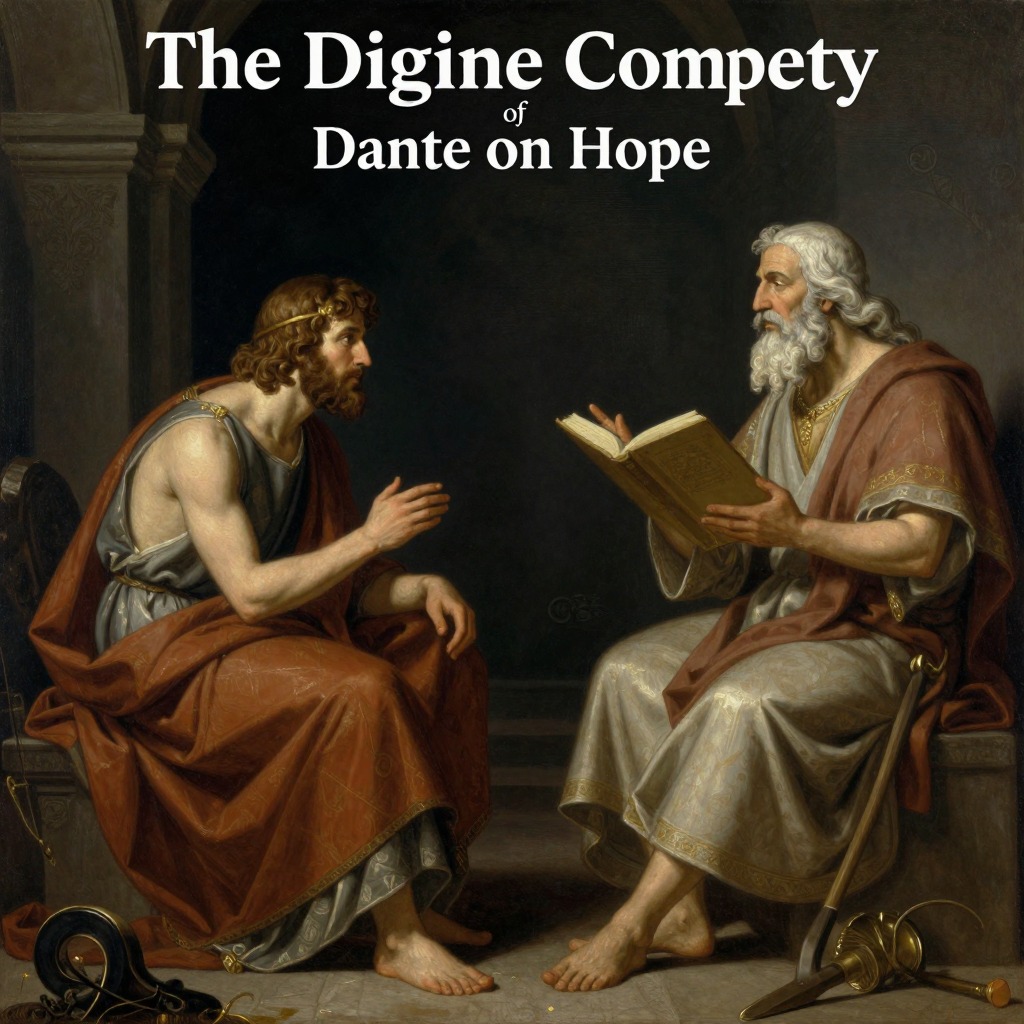
St. James
St. James the Greater, the apostle who witnessed the Transfiguration and whose shrine at Santiago de Compostela became the great pilgrimage goal of medieval Europe, appears in the Heaven of the Fixed Stars to examine Dante on the theological virtue of Hope. His examination is the second of three apostolic tests that Dante must pass before he can ascend to the Empyrean, and it confirms that the pilgrim's hope is grounded in the scriptural promises of resurrection and eternal glory.
Identity and Role
St. James is introduced in the Paradiso as one of the three apostles who were closest to Christ during his earthly ministry. Beatrice identifies him as "the Baron for whom below Galicia is frequented," a direct reference to the immense popularity of his shrine at Santiago de Compostela in northwestern Spain, which was one of the most important pilgrimage destinations in medieval Christendom. His presence in the Heaven of the Fixed Stars places him among the highest ranks of the blessed, and his role as examiner of Hope reflects his own apostolic witness: he was present at the Transfiguration, where Christ's glory was revealed, and he was the first apostle to suffer martyrdom, dying by the sword under Herod Agrippa I. The light that embodies St. James is described as moving toward Dante and the other apostolic lights with the affectionate circling of doves, and it becomes so incandescent that it overcomes the pilgrim's sight.
The Examination on Hope
When St. James speaks, he commands Dante to lift his head and be assured, because what comes from the mortal world must be ripened in the radiance of heaven. He then poses three questions: what Hope is, how it is flowering in Dante's mind, and from where it came to him. Before Dante can answer, Beatrice intervenes with a remarkable declaration: no child of the Church Militant possesses greater hope than Dante, as is written in the Sun that irradiates all the blessed. She states that this is why Dante has been granted the privilege of coming from Egypt (the world) into Jerusalem (heaven) to see before his warfare is completed. She then leaves the remaining two points—the quality and origin of his hope—for Dante himself to answer, confident that he will not find them hard.
Dante responds as a ready disciple, defining Hope as "the certain expectation of future glory, which is the effect of grace divine and merit precedent." He traces the origin of this hope to multiple sources: it was first instilled in his heart by David, the chief singer to the chief captain, who wrote in Psalm 9: "Sperent in te"—"those who know thy name" hope in God. Dante then credits St. James himself with instilling hope through his Epistle, so that Dante is full of it and can rain it upon others. As Dante speaks, the living bosom of St. James's light quivers with sudden and frequent effulgence, like lightning, and the apostle breathes forth his approval, saying that the love with which he is inflamed toward the virtue that followed him to the palm and the issue of the field makes him delight in Dante's telling of what Hope promises.
The Scriptural Grounding of Hope
St. James then asks Dante to declare what Hope promises to him. Dante responds by citing both the Old and New Testaments: Isaiah says that each one garmented in his own land shall be with twofold garments, and his own land is this delightful life; St. James's own brother, St. John, far more explicitly reveals this in the Apocalypse, where he treats of the robes of white. As Dante finishes, the words "Sperent in te" are heard from above, and all the carols of the blessed respond in answer. This moment confirms that Dante's hope is not a vague aspiration but a concrete expectation rooted in the revealed promises of Scripture—the resurrection of the body and the eternal glory of the soul.
The Third Apostle and the Vision of the Incarnate
After the examination on Hope, a third light brightens among them, so brilliant that if Cancer had one such crystal, winter would have a month of one sole day. This light approaches the two apostolic lights in a dance, and Beatrice identifies him as St. John, the one who lay upon the breast of Christ at the Last Supper and who was elected to the great office from the cross. St. John's presence completes the triad of apostolic examiners—Peter on Faith, James on Hope, and John on Charity—and his appearance causes Dante to become so intent that he loses his sight, a blindness that is later healed by Beatrice's radiance. The examination of Hope thus stands as the central test in a sequence that prepares Dante for the final vision of God, confirming that the virtue of hope, grounded in divine promise and sustained by grace, is essential to the pilgrim's journey toward the Beatific Vision.